I
The trigger
What loaded the moment before it started.
Not what she's saying. The underlying state — hunger, transition fatigue, overstimulation — that made the moment almost inevitable.
Not another framework to memorize. The exact sentence, the tone, the position, the comeback for when she pushes back — ready in the three seconds before you lose it.
30 scripts · 90 comebacks · SOS mode · offline · $27 launch.



The books teach you the model. The classes explain the theory. Nobody gives you the exact sentence to say when she's on the grocery store floor at 4:47 PM and everyone is watching. That's not a knowledge gap. It's a translation gap — from theory to the sentence you need in three seconds.

Two screens. One tap each. Built for the 8 seconds you actually have.
That gap — between knowing how to read the moment and knowing what to say inside it — is what The Decoder was built to close. Five moving parts. Read them, and the sentence writes itself. Informed by published research from Perry, Porges, and Tronick.
Not what she's saying. The underlying state — hunger, transition fatigue, overstimulation — that made the moment almost inevitable.
The behavior on the surface — the "I need water," the hit, the fall to the floor — is her shorthand for something she can't yet articulate.
The specific thing she's missing right now — predictable order, brief presence, gentle pressure, a lowered voice, a bounded no.
One line — pre-written, verbatim. The tone below her eye line. The position: kneel, an arm's length, still. Ready in three seconds.
What to do in the silence after — the moment your body finishes what your words started. Tronick's rupture-repair, translated into muscle memory.
Every parenting book gives you element four, half-explained. The Decoder gives you all five — every scenario, every time.
Every parenting brand on Instagram sells you a 55-minute video course. You watch it once, take notes, forget it, and when she's screaming at 4:47 PM you're back to guessing.
The Decoder isn't a course. It's an operational tool. You open it during the meltdown. Tap the trigger. Get the exact sentence. Say it. That's the whole product.
The audio guides are 30–60 seconds. Not a lecture — a coach whispering the technique while your hands are full. The PDFs are for later — when the storm is over and you want to understand why it worked.

Not a better mom. Not a different you. Just the sentence that turned the moment.
Real moms, real screenshots. No paid influencer partnerships, no filters, no stock photos.
Been struggling with my 2.5yo for 6 months. Books, parenting coach, gentle parenting podcasts — nothing was translating to actual sentences to say in the moment.
Someone in my mom group linked this app called Toddler Decoder ($27). It's basically 30 scenarios with the exact script + why it works (Perry sequence). Applied ONE thing — the "predictable order" script at bedtime — and she's asleep in 12 min instead of 90.
Not a paid post, I just wish I'd known about it 6 months ago instead of buying 3 masterclasses.
I'm not being paid to say this — I googled "how to stop yelling at my toddler" at 1 AM and someone had linked this in an old thread.
It's not a course. It's a tool. Like literally you open it when she starts melting down and it tells you what to say. The public tantrum script ("I hear you're upset. We're going to the car. Then we can talk.") kept me from crying in Target yesterday.
Edit: $27 launch price for 30 scenarios + audio guides + 3 PDF bonuses. If it saves me from ONE more parenting course it paid for itself.

I moved to Italy from the States a few years ago. Fell in love with someone here, got married, and eventually there were three small people in the house who needed things from me all day long. My husband works. A lot. Some weeks he's gone before I'm awake and back after they're asleep. Which meant on most days, when the hard moments arrived — and they always arrived at 7 PM — I was the one who had to figure out what to do.
I remember one night in particular. It was around 7:43 PM. My youngest had been escalating for eleven minutes. I'd tried the calm voice. I'd tried the redirect. I'd tried the thing I'd read in a book that morning, the one that was supposed to work. And I felt that familiar tightening in my chest — the one that means I'm three seconds from saying something I'll spend two hours regretting.
That night I understood something. The books were never designed for 7:43 PM. They give you a model. They leave the translation — from model to exact sentence under pressure — entirely to you. And under stress, translation is exactly where it breaks down.
So I stopped trying to become a better mother by reading more, and I started building the sentence itself. The exact one. In the tone that works. From the position that works. With three ready alternatives for when she doesn't respond the first time — because she often doesn't. I built it backwards from the moment the words disappear.
The first night I used it, my son was asleep in nineteen minutes. My parenting hadn't changed. I just had the exact words loaded before the moment asked for them. That was the only difference. And once I saw it, I knew this wasn't going to stay something only I used.
Instant delivery · works offline · opens like an app · arrives in your inbox in under 60 seconds.
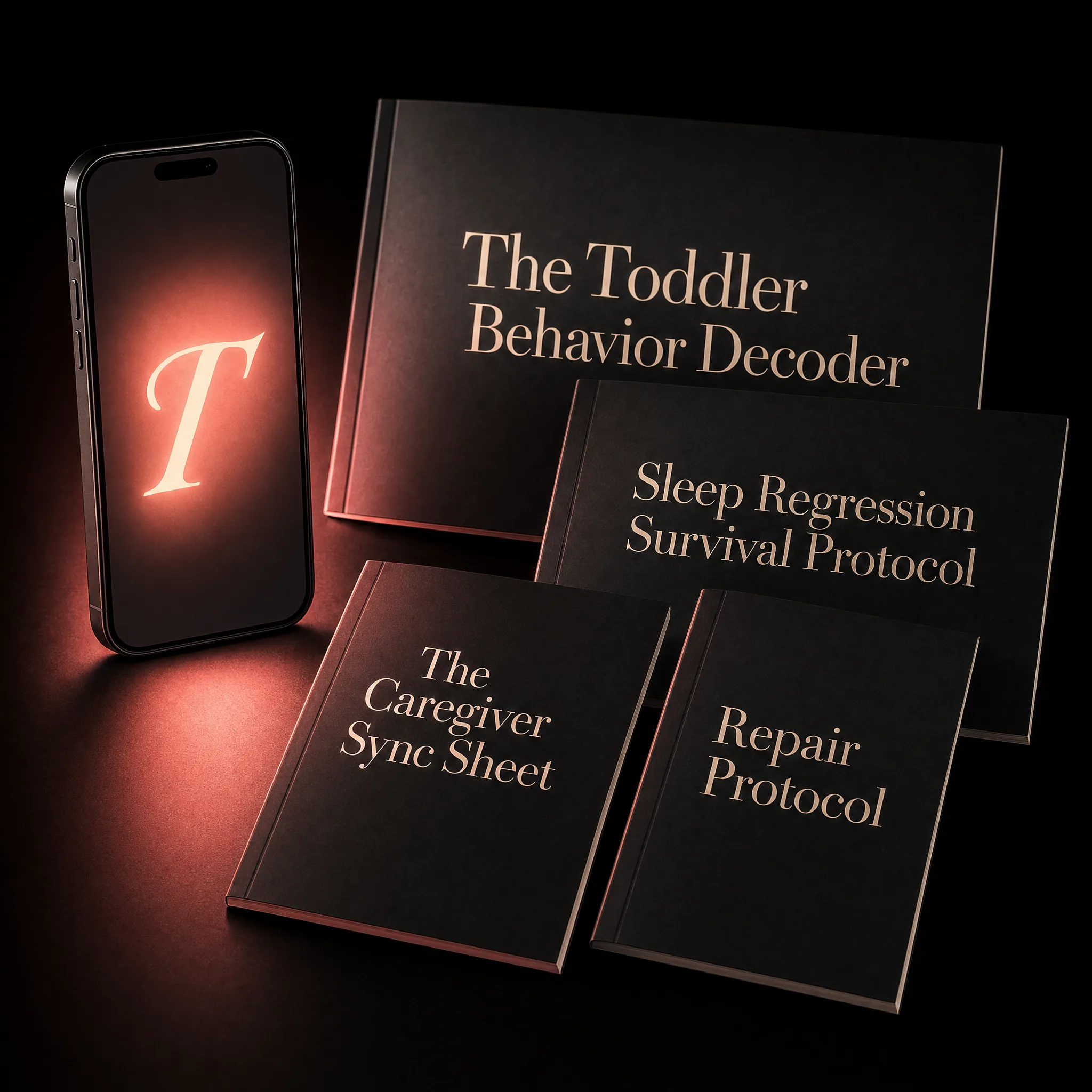
You receive one small thing that behaves like several bigger ones. A tap-and-play app that lives on your home screen. A guide you'll actually reread. Three bonuses that solve the moments the app doesn't. Below, in order of appearance.
30 exact scripts. 10 behaviors × 3 contexts. Each one with scene, tone, voice level, position, and 3 pre-written pushback comebacks for when they talk back. Plus a built-in Print. Fold. Carry. wallet-card generator — for the diaper bag, the glove-box, the fridge.
Five one-tap cards matched by how you feel — "one breath from yelling," "heart racing," "frozen." A voice in your ear walks you through the technique. No reading, no scrolling.
Five before the storm. Five in the storm. Five after. Thirty to sixty seconds each. A warm voice walks you through the technique while your hands are full.
Four volumes. Seventy-plus pages. The 5-Element Framework explained, all 30 scenarios expanded, Perry sequence, case studies. For the quiet Sunday when you want to understand why.
Save the scripts that worked. Streaks and "it worked" tracking. A weekly pattern insight — tells you which trigger is most active this week.
Three PDFs that solve the moments the main app doesn't. Each one delivered in deck and printable formats.
The 18-month, 2-year, and 2.5-year regressions decoded. What's happening in her brain, what to do, and when to stop trying.
For grandparents, nannies, partners. The 12 scripts everyone in her circle should know — one calm response, not five.
When you lost it. When you yelled. When you regret it. The exact 4-line sequence that heals the rupture without minimizing.
Less than one parenting workshop ($95). Less than one weekend of takeout ($120). Built to work for years.
Less than one parenting workshop ($95). Less than a weekend of takeout ($120). Built to work for years.
Try every script for thirty nights. Apply the five techniques you reach for most. If your evenings aren't objectively calmer — if you're not saying fewer sentences you regret — if the app doesn't earn its space on your home screen — email us and get a full refund. The risk is entirely on us.
Because a promise you can't return isn't a promise.
It's a purchase.
Every scenario in The Toddler Decoder includes the Pushback System — three pre-written parent responses to the three most likely toddler comebacks. Ninety total across thirty scenarios. Plus an alternate script and repair language. You never get stranded at the moment your toddler pushes back against the first sentence.
Every purchase of The Toddler Decoder includes the Caregiver Sync Sheet™ — a printable with the twelve core scripts everyone in your child's circle should know. Print, put it on the fridge, done. Grandparents, nannies, and partners all respond with the same calm language, so your toddler stops hearing five different answers to the same behavior.
The opposite. There is a dedicated SOS Storm Mode — five one-tap emergency techniques with audio, matched to how you feel in the moment. No reading during the meltdown. Plus ten more techniques in the main guide. The Toddler Decoder treats you like an adult who is tired, not a project to fix.
Yes. Thirty days, full refund, no explanation required. Email us and the refund is processed within forty-eight hours. You keep every script, every audio, every PDF. Zero risk on your side — the Ready-Parent Promise is designed so you can try everything before deciding.
The Toddler Decoder is a digital product with no inventory, no subscription, and no influencer ad budget. The standard price is $47. The Founder Edition launch price is $27 as a thank-you for being early. When the launch window closes, the price returns to $47 permanently.
Toddler tantrums typically peak between 18 and 36 months, with the strongest frequency around ages 2 and 3. By ages 4 to 5 they drop sharply as language and self-regulation develop. The Toddler Decoder is designed exactly for this window — scripts tuned to the stage where protest outruns language.
Yes. Zero to Three classifies toddler hitting as a developmental stage, not a red flag, peaking around age 2 when big feelings outrun words. It usually comes from immature communication, weak impulse control, overload, hunger, or tiredness. The Toddler Decoder provides scripts that name the limit and offer language, not punishment.
Bedtime stalling responds best to a short, repeated exit line and no negotiation: "I love you. It's sleep time. See you in the morning." The payoff for stalling is the extra conversation — remove that payoff and the behavior fades. The Toddler Decoder includes the full bedtime script library with repeated phrasing.
Yelling usually happens when working memory is full and no pre-rehearsed sentence is available. The fix is not more self-control — it is having the exact words ready before the moment arrives. The Toddler Decoder gives you those sentences in advance so a calmer reply becomes the default, not the exception.
A tantrum is a goal-directed protest — your toddler wants something and is pressuring you to give it. A meltdown is nervous-system overload, where your toddler is no longer in control of the response. The two require different scripts, and The Toddler Decoder labels which category each scenario belongs to.
Instant delivery. Works on any phone.
Refund policy that respects your intelligence.